Thornbound
Seven weeks
Time Period
13 Developers
Team
Level Designer,
Narrative Designer
Areas
Unreal Engine 5
Engine
Concept

Castle Kravia
Beat 1: Tutorial Transition
Giving players their first moment of agency after the tutorial. This space is meant to gently introduce tension, test combat mechanics, and let players decide their approach.
Design goal
Ease players into freedom after a guided tutorial. Create a moment of tension and curiosity where the player feels in control.
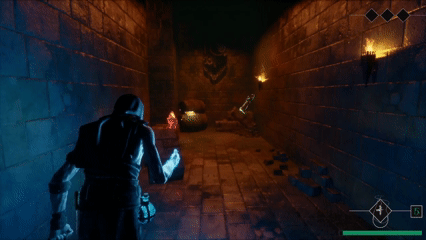
I introduced a long hallway with a patrolling enemy at the far end. The player had just learned the basics and the lightning spell, so this was the first real test. To support stealth or direct attack, I carefully tweaked the patrol path to give players a "calm before the storm" moment. The enemy is framed down the corridor to immediately draw attention.
Implementation
Iteration
I had to tune the enemies speed and pathing so they don't instantly spot the player and to leave room for the player to have a calm moment before deciding on what approach they want to do next.If they want to attack stealthily or head on.


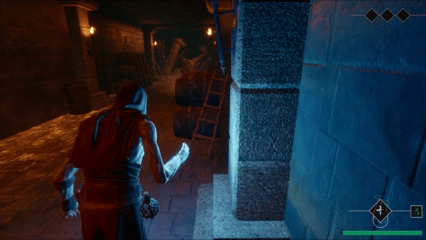

Level Walkthrough
Beat 2: Junction &
New encounter
Using branching paths to introduce narrative flavor and subtle player guidance. Reinforcing exploration with visual cues and reactive enemy placement.
Design goal
Create subtle choice through blocked paths while blending environmental storytelling with tension.
After the first enemy, the path splits. The "main path" is blocked, nudging players into a note room (dead end) or a darker room with an ammo pickup. One is narrative-focused, the other gameplay-focused. The ammo is emissive and draws attention, but stepping near it wakes a sleeping enemy placed in shadow.
Implementation
Iteration
Working with the lighting artist, we ensured the sleeping enemy was visible just enough to build suspense. Early versions made the jump-scare feel unfair. I adjusted lighting contrast and enemy trigger radius to balance fear with clarity.


Level Walkthrough
Beat 3: Encounter Build-up
Expanding player agency through multi-path encounters and rewarding curiosity with environmental storytelling and resource balance.
Design goal
Escalate pacing and stealth challenges while encouraging exploration and resource management.
This area branches into a curved hallway with two patrolling enemies, followed by a room junction with these enemies walking in/out of side rooms. Player must plan their timing or unleash spells. Each room contains a different reward: ammo or healing and lore. The hallway after this is long, cold, and dark to build suspense.
Implementation
Iteration
Initial enemy placement made stealth option too difficult.
I tweaked on the patrolling pathing to allow more player agency as well as encourage exploration into the rooms nearby.

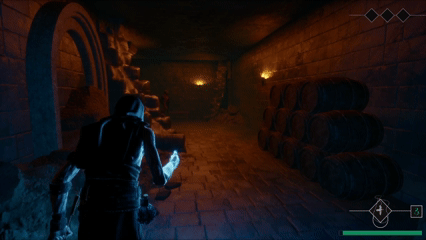

Level Walkthrough
Beat 4: Puzzle Battle
Blending enemy encounters with puzzle-solving. Balancing visibility, challenge, and resource constraints to maintain pacing and tension.
Design goal
Combine puzzle-solving with active enemy threat to increase pressure and create a dynamic test of skill.
This arena area features a 4-target lightning puzzle. Player recognize the mechanic from the tutorial, but now ammo is limited and enemies are present. Some puzzle crystals are hidden in adjacent rooms, forcing exploration under threat.
Implementation
Iteration
Originally, puzzle targets were too hard to see and ammo was insufficient. I learned not to place critical objects above eye level without cues. I also rebalanced ammo placements and added a checkpoint system to reduce frustration from soft-locks.

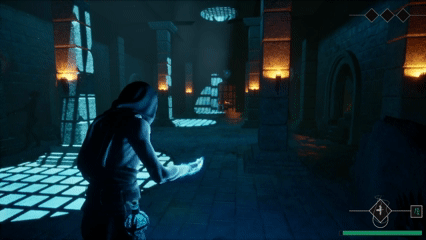
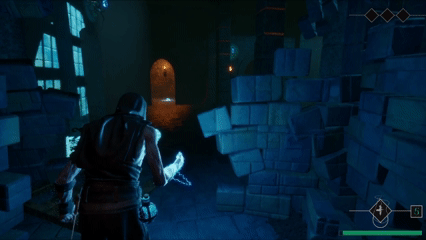
Level Walkthrough
Beat 5: Fire Spell &
First Fire Puzzle
Unveiling the fire spell and using visual and spatial design to ease players into a new mechanic while raising stakes through surprise.
Design goal
Introduce a new spell (fire) in a way that naturally invites experimentation and forward momentum.
The player gets the fire spell, a statue piece and a note with context for the endgame puzzle. The upcoming puzzle room introduces braziers. I designed it to be intuitive, one brazier is already lit, the other is unlit. A broken stair teases an enemy encounter and a foreshadowing moment.
Implementation
Iteration
The initial puzzle had 4 unlit braziers, which confused players. I simplified the objective to 1 unlit + 1 lit as visual guidance. We placed a QTE enemy near a healing plant to flip the mood from safe to startling, enhancing pacing.


Level Walkthrough
Beat 6: Castle Hall &
End puzzle
Opening up the space to let players explore and collect. Using lighting and layout to subtly guide players toward objectives and secrets.
Design goal
Reward players with exploration and context while introducing a light multi-step puzzle.
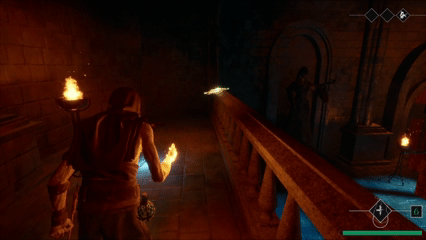
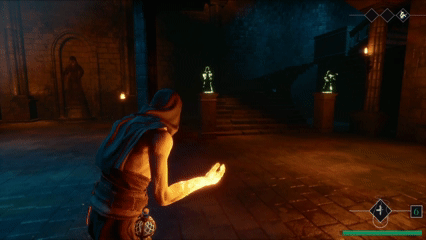
The castle hall is large and open, filled with optional routes and roaming enemies. I used lighting and space shaping to draw attention to the statue puzzle room beneath the staircase. The player sees one statue piece already placed and receives a hint note nearby.
Implementation
Iteration
Originally, the puzzle involved assembling one single statue, too complex for time constraints. I redesigned it into four pieces across the level. Environmental cues like light placement and rubble guide the player subtly toward key areas.

Level Walkthrough
Beat 7: Upper Hallway &
Final Segment
Pacing a final stretch of enemy interactions and narrative beats before puzzle resolution. Combining stealth, combat, and reward structure.
Design goal
Culminate pacing and enemy mastery while tying up the collectible puzzle loop.
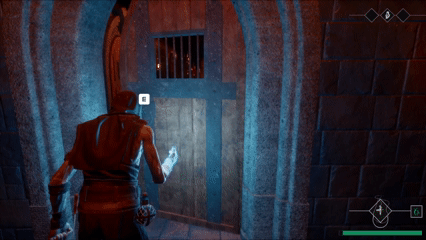
The player enters a long hallway with patrolling enemies and a hidden crawler enemy waiting in a corner. Depending on approach, the player can stealth through or engage. A final room offers a last statue piece and another note. Players must then return to complete the statue puzzle.
Implementation
Iteration
Playtests showed some players feeling like the combat was "clunky" so I thinned them out and spaced them for better balance between stealth and chaos making the combat encounters feel more natural in general.


Level Walkthrough
Level WALKTHROUGH
Level Design
For this project, I took inspiration from the Resident Evil games, specifically Resident Evil 2 and 8. I wanted to capture a similar feeling in their puzzle and encounter design as well as how lively and unsettling the interior spaces are within those games.
To give clarity in guidance, I made use of lighting with help from our lighting artist and spatial cues in the structure and dressing.
Through focus on verticality and spatial compression and expansion, I gave the player a dynamic experience where some spaces are narrower and others wider to give different senses of pressure and comfort.

Setup
My initial course of action was to get straight into making sketches of the layout for the levels, I tested back and forth with blockouts and observed how small tweaks can spark different emotions within the player.
I wanted to keep the player on edge, with a large number of elements within the game such as puzzles, enemies and narrative, I could freely blend and distribute them throughout my levels.
-
I made fast iterations on enemies through communication and testing in order to balance the difficulty of encounters and puzzles.

-
I made sure player can freely decide between a stealth or attacking approach through most encounters, rewarding both options in different ways.


Throughout the process I had to iterate plenty of times to really refine things to the state they are in today. But I also have to give credit to my team for how good the dynamic was and how well everyone were communicating, which made the project both successful and fun!
Narrow Space
Pre-Alpha Blockout
In-game Highlights
Development Gallery


Sketch > Blockout > Finished
-
Through iterations, I made a clear progression and learning curve throughout the levels
-
I blended and iterated player mechanics and puzzle design.
-
I made dynamic enemy encounters to enhance curiosity.
-
I integrated narrative and quest design through environmental storytelling and collectibles.
-
I made unconventional pathing to attract player attention and decision-making
-
I balanced consumable pickups through iteration for encounters and rewarded exploration.
-
I worked with scale to spark uncomforting emotions as well as to enhance different encounters.
Wide Space
Narrative
As well as I was a level designer, I also was the narrative designer.
Compared to the previous project, I had a lot of creative freedom and the liberty to include more than just implicit storytelling, even though this was still a school game project in the end
Since the inspiration for this project was tied to Resident Evil, I wanted to use inspiration from the strong parts of those stories, where the player/character has a good motivation for going through treacherous areas and not giving up.
I also wanted to explore ways of having an implicit story running at the same time and through that, give the experience of two stories at once. The direct one the player knows from the start, and the underlying one which the player can discover through exploration and curiosity.
As mentioned before, you play as a retired mage on a quest to get the only remedy for your granddaughter's sickness. That remedy is the rare flower Virellis, said to cure any injury or illness, which remains in Castle Kravia.
The underlying story takes place within this castle, where previous trespassers have tried to use the flower for their own selfish reasons, which forced them into eternal duty guarding the halls.


Gallery of narrative implements within the game
-
Through communication, feedback and setbacks I made iterations on the story and how it plays out to make sure there's an aligned vision.
-
I wrote and set up "past events" with the help of artists, which the player can find throughout the castle to enforce the idea of "previous trespassers".
-
I set up a note system where I could place a note anywhere to leave traces of past characters and how their fate ended, with some using their reasonings to indicate what kind of creature they turned into
-
Using these notes and past events, I set up a dynamic experience where the player can get affected by previous characters stories, guidance/hints on the quest and the background behind everything within Castle Kravia


Gallery of narrative cinematics and extra
-
I worked on the story progression of the game, where the player starts within the story, how it ends and what happens along the journey.
-
I wrote the intro and ending cinematics, as well as the voice lines within the first cinematic, collaborating together with our animators and our sound designer.
Challenges
&Solutions
Puzzle Difficulty
-
-
There was a lot of testing when it came to puzzles and even though it may be clear to the creator, the player is gonna perceive things in all sorts of ways. When it came to our lightning puzzle, there was an issue with players not noticing all the spots, but that was because they were hard to find and at an uncomfortable height.
-
The solution to that was to firstly lower them to a smooth height because players can't be expected to look up, and I also made sure that they were easier to find in general by putting them along paths and eye traces, like the first thing you see after you turn a corner.
-
-
Another challenge within the puzzles was the fire puzzle onboarding, where the player needs to light a brazier with their fire magic. There were too many braziers to find, and combined with them being a new unknown element it was hard to understand.
-
The solution for this was to lower the amount of braziers, from four to two, placing them right next to each other and lighting one of them to indicate what might happen when the player tries to light the other.
-
-
-
-
The ammo amount affected the whole game, where it's used for encounters and puzzle-solving. This was a bit of a struggle because there has to be enough ammo for the player to complete the upcoming puzzle, otherwise they would be locked and have to try again. On the other hand, if there was too much ammo, the player would have it too easy during encounters and we really valued the tension of having low ammo.
-
To solve this, I enhanced enemy pathing in order to reward players to take a stealth approach and saving ammo. At the same time I also left breadcrumbs of ammo to reward exploration.
-
-
Balancing Ammo Amount
Reflection
Puzzle Understanding
-
As the puzzle designer, you really need to iterate on people's understanding of it and consider if your target group is used to/should understand it. If there weren't as many playtests as we had during this project, the puzzles wouldn't be the same quality.
-
Even though this team was filled with brilliant minds, a team as large as this means communication is still very vital. By holding meetings every day and not being afraid to ask for help/feedback, it's going to improve the process massively
-
Scaling affects everything, and I truly realized its value. It affects the player's experience in many ways, like the emotions created from having a narrow short hallway or how easy it is to see something like an object hanging high on a wall. It also affects development, how the artists work and how the art and lighting are set up for example. A clear vision of scale and the communication of it is key.
Communication + Team Size
The Value of Scale